
This is a Premium feature.
Starting from version 1.6.1 (Premium), you can allow your users to submit videos from your website front end.
Follow the steps below to enable this feature.
- Enable User Registration
- Configure Video Form Options
- Add the Video Form to Your Site Front-End
- Restricting Categories in the Video Form
1. Enable User Registration
All-in-One Video Gallery requires users to have a member account on your website to submit videos. Therefore, the first step is to enable user account creation in your WordPress settings.

- Navigate to Settings → General from your WordPress Admin Dashboard.
- Find and enable the “Anyone can register” option.
- Save the changes.
This is a built-in WordPress option that allows users to register an account on your website.
Note: By default, the plugin uses WordPress’ built-in registration form. If you use a third-party registration plugin, you can configure the plugin to use your custom registration system as explained here.
2. Configure Video Form Options
The next step is to configure the video submission form to match your requirements.
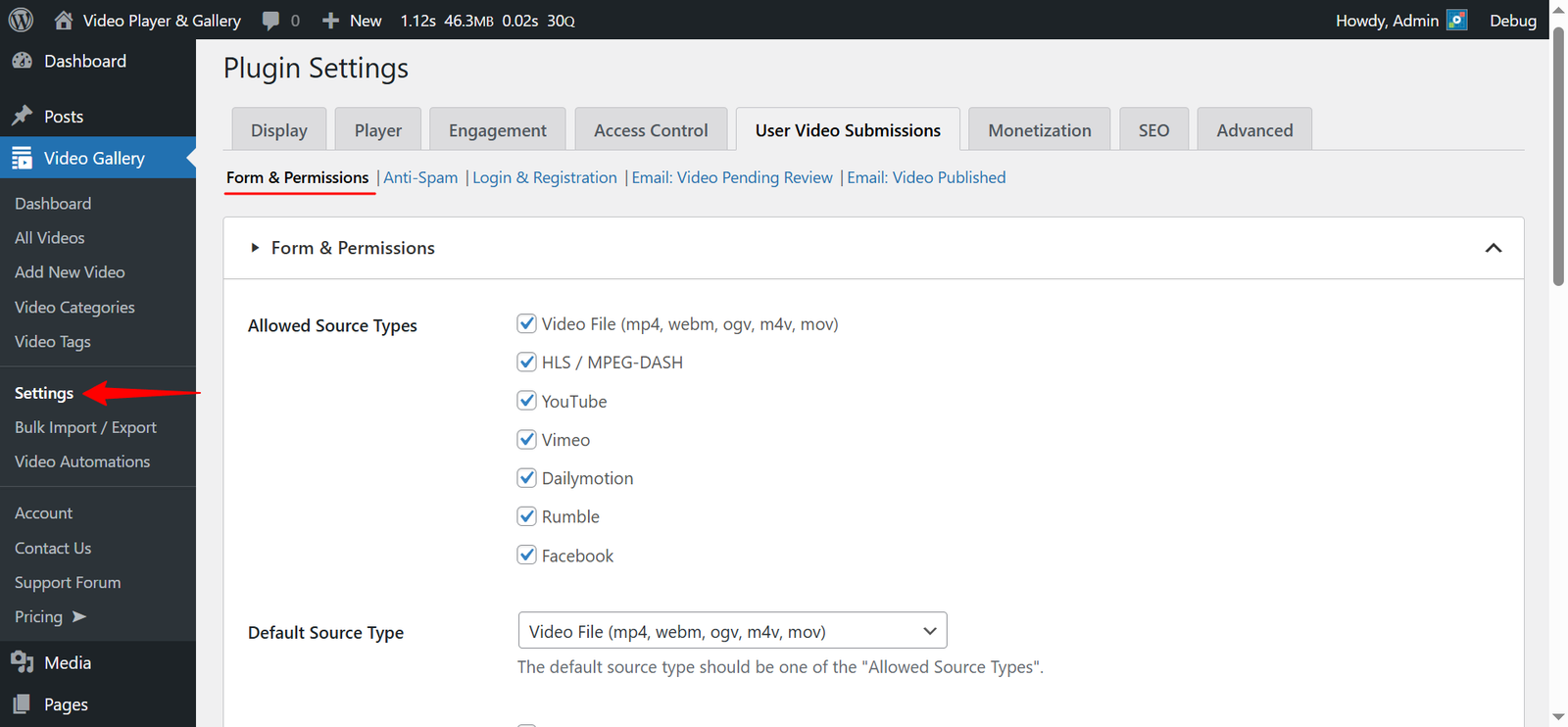
- Navigate to Video Gallery → Settings from your WordPress Admin Dashboard.
- Click on the User Video Submissions tab.
- You will find several submenus under this tab related to the front-end video submission feature. Each section includes clear explanations and helpful hints. Simply fill out the form according to your requirements or leave the default settings as they are.
Form & Permissions
This is the primary settings page for managing user video submissions. Here, you can specify the allowed video sources, define default submission statuses, and customize various other options to control how users contribute content to your website.
- Allowed Source Types
- Self-Hosted / External URL
- Adaptive / Live Streaming (HLS, DASH)
- YouTube
- Vimeo
- Dailymotion
- Rumble
- Use this option to restrict the video sources users can submit.
- Default Source Type
- The default source type must be one of the Allowed Source Types.
- Assign Categories
- Enable this option to allow users to select categories for their videos.
- Categories are managed under Video Gallery → Video Categories.
- You can restrict users from assigning videos to specific categories (explained later in this tutorial).
- Assign Tags
- Allow File Uploads
- Enable this option to allow users to upload video files to your website.
- Allowed File Formats
- MP4
- WebM
- OGV
- M4V
- MOV
- JPG
- PNG
- GIF
- Use this option to restrict the file formats users can upload.
- Maximum Upload Size
- Enter the maximum file size (in bytes) users can upload.
- Leave this field empty to allow the maximum file size supported by your server.
- Default New Video Status
- Set the default status for newly submitted videos.
- Recommended: Set this to Pending so that admin approval is required before publishing.
- The admin will receive an email notification when a video is submitted and pending review.
- Users will be notified by email when their video is approved.
- Edit Video Status
- Set the default status when a user edits an already published video.
- Recommended: Set this to Pending to require admin review before re-publishing.
- Terms and Conditions URL
- Optionally, enter a URL to your Terms and Conditions page.
Anti-Spam Protection
Enabling user submissions through the front end may lead to spam. All-in-One Video Gallery includes built-in anti-spam features. It is recommended to enable all available anti-spam techniques in the plugin settings.
Login & Registration
By default, the plugin uses WordPress’ built-in registration form. If you use a third-party registration plugin, you can configure the plugin to use your custom registration system on this page.
Email Notifications
- Email: Video Pending Review
- If the New/Edit Video Status is set to Pending, an email is sent to both the site admin and the user.
- This page contains the Pending Review Email Template, which you can customize.
- Email: Video Published
- This page contains the Video Published Email Template, which is sent when a user’s video is approved and published.
3. Add the Video Form to Your Site Front-End
Once you’ve configured the plugin settings, it’s time to enable a menu for users to submit videos from the front end.
During plugin activation, the following pages are created automatically:
- User Dashboard: Displays all user-submitted videos with options to edit, delete, or add new videos.
- Video Form: The form page where users submit new videos.
Navigate to Appearance → Menus from your WordPress Admin Dashboard, and add these pages to your website’s menu.
That’s it! Users can now submit videos from the front end.

4. Restricting Categories in the Video Form
If the Assign Categories option is enabled, a category selection dropdown appears in the video submission form.
By default, this dropdown includes all categories created in the plugin. However, you may want to restrict users from selecting certain categories.

- Navigate to Video Gallery → Video Categories from your WordPress Admin Dashboard.
- Edit the categories you want to exclude.
- Find the “Exclude in Video Form” setting.
- Check the option and save the changes.
Once excluded, those categories will no longer appear in the Assign Categories dropdown in the video submission form.
This completes the setup for enabling front-end video submissions. 🎥🚀